
Heavy overnight rain in Gurugram caused widespread waterlogging and traffic gridlock, bringing the city to a standstill. Several residential areas and major roads were inundated, leading to commuter chaos.

Unseasonal rains interrupted the sweltering heat in Delhi and Gurugram on Monday while rain clouds gathered in sultry Lucknow.
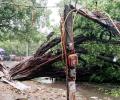
A three-hour heavy downpour accompanied by a dust storm hit Delhi-NCR early morning on Friday, causing flight delays and traffic disruptions as seven people were killed in rain-related incidents across north India.

Glimpses of the Bharat Bandh called to protest the Agnipath scheme, June 20, 2022.

Mornings in many north Indian cities are enveloped by fog and smog, with poor visibility.

With protesting farmers seeking to march to the national capital, security remained tight on Wednesday with personnel deployed in huge numbers and barricades regulating movement in central Delhi and at border points with Haryana, which can cause hardships to commuters.

Glimpses of the devastation caused due to heavy rainfall in the national capital and other parts of northern India.

The Punjab and Haryana high court Tuesday issued notices to the Centre, and the states of Haryana and Punjab, on two separate petitions filed pertaining to the farmers' Delhi Chalo march.
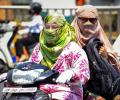
Gurugram in Haryana witnessed a scalding 48.1 degrees Celsius, the highest since May 10, 1966, when the city logged 49 degrees Celsius.

Parts of Delhi witnessed traffic jams on Monday as the traffic police closed off several roads ahead of the Congress's protest against the Centre's Agnipath scheme and "vendetta politics" in targeting Rahul Gandhi.

Hailstorms were reported at various parts of the national capital including Palam, Chilpighat and Ayanagar, the IMD said.

Major roads in and around Delhi including on the DND flyover and Ghazipur border were affected from the morning rush hours till around 2 pm.
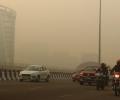
Authorities on Friday had advised people to limit outdoor activities and told government and private offices to cut vehicle use by at least 30 per cent as air quality in Delhi-NCR inched towards the emergency level amid a rise in emissions from farm fires and unfavourable meteorological conditions.
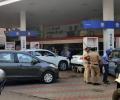
The Delhi government has announced that vehicles older than 15 years will be denied fuel at petrol pumps starting April 1.

The national capital has been witnessing an incessant spell of light to moderate rain for the past two days.

The city's Air Quality Index (AQI) stood at 420 at 8 am on Thursday, compared to 426 at 4 pm on Wednesday. The AQI map prepared by the Central Pollution Control Board showed clusters of red dots (indicating hazardous air quality) spread across the Indo-Gangetic plains.
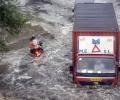
A record 119.3 mm rainfall pounded Delhi under the impact of cyclonic storm Tauktae and a western disturbance in 24 hours ending 8:30 am on Thursday, breaking all the previous records for May, the IMD said on Thursday.

Amid a spike in pollution levels in Delhi-NCR, the Supreme Court on Tuesday directed Punjab, Haryana, Uttar Pradesh and Rajasthan to ensure crop residue burning was stopped "forthwith", saying it cannot let "people die" due to pollution.

Delhi is likely to receive the first monsoon showers on June 30 or July 1, India Meteorological Department (IMD) officials said on Tuesday.

Climate change has hampered the ability of the forecasting agencies to accurately predict severe events and weather bureaus across the world are focusing on augmenting the observational network density and the weather prediction modelling to improve predictability, India Meteorological Department (IMD) Director General Mrutyunjay Mohapatra has said.

How can highways be blocked perpetually, the Supreme Court wondered on Thursday while referring to road blockades by farmers protesting at Delhi borders against the three farm laws passed last year, and said it is the executive's duty to implement the law laid down by the court.

Road and rail traffic was partially affected in some regions on Monday during a 'Bharat bandh' called against the Agnipath military recruitment scheme, while protests appeared to taper off in many states, with authorities stepping up security and imposing curbs after days of unrest.

According to the Graded Response Action Plan (GRAP), the air quality is considered to be in the emergency category if the PM2.5 and PM10 levels continue to be above 300 micrograms per cubic metre and 500 micrograms per cubic metre respectively for 48 hours or more.
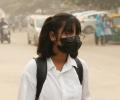
'Pollution acts as an endocrine disruptor.' 'When it acts as an endocrine disruptor it has an effect on the endocrine system of the human body and the effect on the pancreas is an important one.' 'The way you get type two diabetes is due to two defects.' 'One is the pancreas doesn't produce enough insulin.' 'The other physiological defect is insulin resistance.'

The national capital is expected to continue receiving moderate rainfall with some isolated intense spells for the next 24 hours, the India Meteorological Department said on Monday.

According to the India Meteorological Department (IMD), the Ayanagar weather station recorded 99.2 mm rainfall, the maximum in the city, during the 24-hour period ending at 8.30 am on Thursday.

Repeated spells of rain pushed traffic out of gear, leading to snarls that would give anyone a nightmare.

Modi and Shah can't afford to lose any of the 24 per cent Dalit vote of 2014, says Shekhar Gupta.

Defying prohibitory orders, protests were held in Delhi, Bengaluru, Hyderabad and several other cities. Protesters, mostly students and activists, were detained on a large scale in national capital and other places.

'It is very hard to get the police to file a report against someone from an upper caste.' 'Things are so bad that sometimes we have to sit on a dharna with the body of a Dalit victim to get the police to file a complaint.'

Incidents of arson, firing and vandalism were reported from Madhya Pradesh, Rajasthan, Uttar Pradesh, Bihar and Punjab as protesters agitated against the dilution of the SC/ST Act.
